Why stone lithographs should rest flat
Stone lithography prints are made on paper, so they respond to pressure, moisture and heat. If a print is rolled, bent or stacked badly, the sheet can crease and the image may suffer at the edges. Flat storage helps keep the paper fibres settled and protects the surface from scuffing.
For collectors in Woodstock, Sea Point or Newlands, the biggest risk is often not dramatic damage but slow wear. A print moved from shelf to shelf, or kept in a warm room with uneven humidity, can pick up ripples and dull handling marks over time.
The best materials for safe short term storage
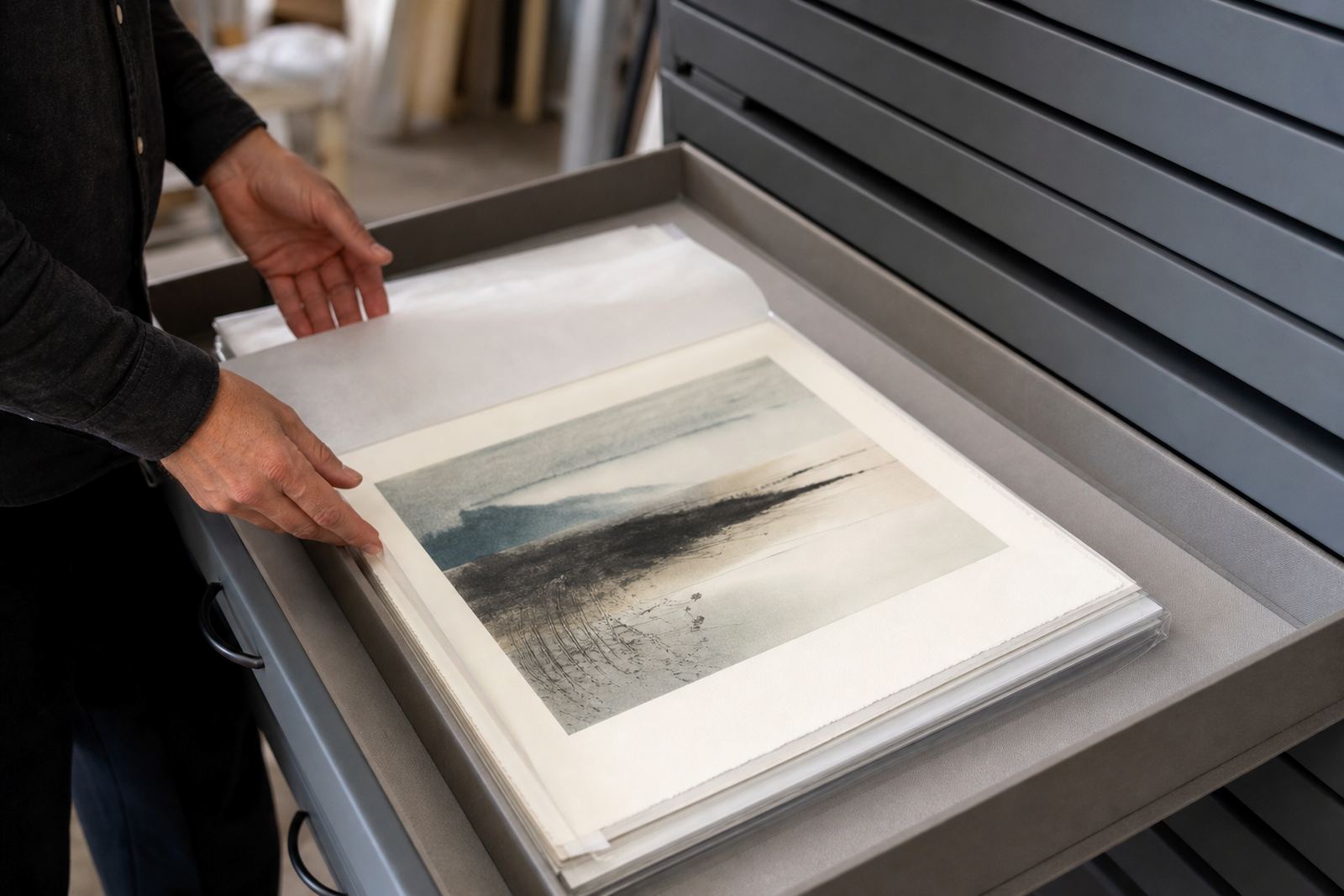
Good storage starts with materials that do not react with the print. Use clean interleaving sheets, acid free folders and rigid support boards if the work needs extra protection. Avoid plastic sleeves that trap moisture unless they are made for archival use and the print is fully dry.
- Store each print in a separate archival sleeve or folder
- Place a stiff board under larger sheets to prevent flexing
- Keep prints away from direct sunlight and heaters
- Use clean cotton gloves or wash and dry hands well before handling
If a print is being kept for a viewing later in the week, a flat archival box is usually better than a stack on an open shelf. It keeps dust off and helps stop corners from turning up.
How to stack prints without marking them
When you need to store several unframed prints together, keep the stack level and light. Place a sheet of acid free tissue or glassine between each work, then support the whole pile on a flat surface that does not bow in the middle. Never place heavy objects on top unless the prints are already boarded and the pressure is even.
In our studio, we often advise collectors to keep editioned prints separated by title and size, with a note on the front sheet for easy identification. That small step saves time later and reduces the chance of handling the wrong sheet. A tidy stack also makes it easier to spot foxing, cockling or tiny edge dents before they become a bigger problem.
- Do not mix dry and damp prints in one stack
- Keep stacks small enough to lift with one hand
- Use labels on folders, not on the print itself
- Check the top and bottom sheets every few weeks
Cape Town humidity and the problem of paper movement
Coastal humidity can make paper move, even when the print looks perfectly flat. In summer, a room near an open window may become damp in the morning and dry by afternoon, which can cause slight waviness or cockling. This is common in Sea Point and parts of the city bowl, especially where air flow is limited.
The answer is not to seal prints away completely, but to keep the storage area steady. Choose a room with moderate temperature, no leaks and no direct sun on the storage box.
Preparing prints for a viewing or sale
Before you show an unframed print, let it come to room temperature in its folder before opening it. Sudden handling straight from a cool storeroom into a warmer room can lead to condensation on the paper. Open the folder on a clean, dry table and support the full sheet when moving it.
If the print is going to a collector in Johannesburg or Pretoria, pack it flat in a rigid mailer or archival box with corner protection. For local handover in Stellenbosch or Durban, the same principle applies, keep the sheet supported and do not tuck it under other items in a car boot. A print that arrives flat is much easier to frame and enjoys a better start in its new home.
When to ask for studio advice
Some prints need more than ordinary home storage. If you have a large sheet, a delicate paper type, a fresh edition or a work that has already curled, it helps to speak with the studio before packing it away. We can advise on paper choice, archival wrapping, edition handling and whether a print should be left flat or lightly press-stored for a short time.
Collectors often ask about framing too, but storage comes first. A well stored print is easier to frame later, and less likely to need correction. If you are unsure about a sheet that has picked up marks, do not try to flatten it with heat or iron it, that can do more harm than good.