Why limited editions matter to collectors
A limited edition gives the work a defined life. Once the edition size is agreed, each print is made to the same standard and recorded with care. That matters to collectors because it keeps the work accountable and easy to understand. A lithograph is not a reproduction in the casual sense, it is a hand-pulled print made from a process that carries the artist’s decisions into each impression.
We work with collectors in Cape Town, Stellenbosch, Johannesburg, Pretoria and Durban who want prints that are properly editioned and well handled. For many buyers, the appeal lies in the balance between original mark making and the repeatable nature of the medium. It is art with a strong physical presence, and each sheet has the small variations that come from real printing rather than mass output.
How we work with artists on each edition
Our studio work is collaborative. We sit down with artists at the planning stage, talk through the image, the number of colours, the size of the stone and the paper choice, then map out the edition from there. Some projects call for a single stone with a strong tonal drawing, while others need several stones for layered colour separation and exact registration. We keep the process practical, clear and honest, so artists know what each decision means for the final print.
Shailen Naicker oversees the studio direction, while Nomvula Phalatse leads the printing side and Stefan Hattingh supports day-to-day technical work. Rukshana Kamaar manages edition records and client coordination, Bonga Mngadi assists with editioning, and Tegan Jacobs handles studio visits and collector queries. We work as a small team, which means nothing gets lost in the shuffle and every print gets proper attention.
- Edition planning for one-colour and multi-colour works
- Proofing sessions to refine tone, registration and surface detail
- Signing and numbering so each impression is clearly documented
- Archival packing for collectors across South Africa
Paper, colour and the practical side of fine printing
Good lithography depends on the details that are easy to overlook. Paper choice affects absorbency, texture and how colour sits on the sheet. Stone preparation affects how evenly the image holds. Colour separation affects the accuracy of the final print. We test these things in the studio rather than leaving them to chance, because a print edition needs consistency from start to finish.
We also advise on framing coordination and collector handling. Prints should be stored flat, away from direct sun and out of damp conditions. In coastal areas like Sea Point and parts of Cape Town the air can carry more moisture, so we recommend archival sleeves, acid-free materials and careful wall placement. If a collector is unsure how to keep a print safe, we talk through the basics in plain language, no drama, just what works.
- Keep prints out of direct sunlight to slow fading
- Handle sheets with clean dry hands or cotton gloves
- Store flat in archival materials, not rolled up for long periods
- Allow framing with acid-free mount board and UV protective glazing where suitable
A Woodstock studio built around stone lithography
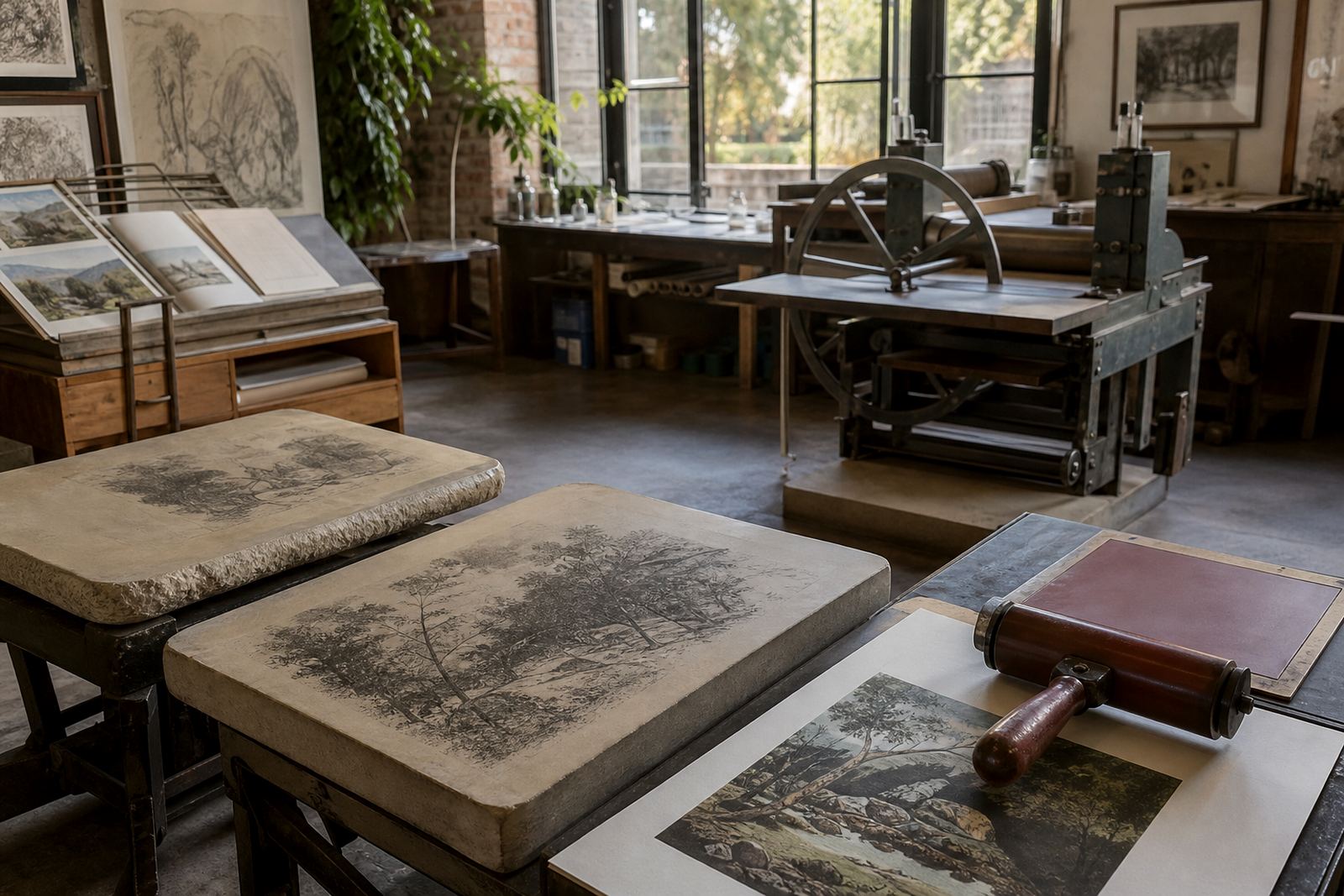
We are a dedicated stone lithography studio based in Woodstock, Cape Town, where the work begins with the stone itself. Lithography is a planographic printmaking process, which means the image sits on a flat surface rather than being carved into it. The drawing is made with greasy materials on limestone, then the stone is treated so the drawn areas accept ink and the rest repels it. Paper is pressed against the stone under controlled pressure, producing each print by hand.
That process asks for patience, accurate timing and a steady studio hand. It also suits artists who want subtle mark making, velvety blacks, layered colour and a tactile surface that feels true to the original drawing.
Studio visits, proofing and edition control
Our studio visits give artists and collectors a chance to see the process up close. During proofing sessions we check image strength, colour balance and paper behaviour, then make adjustments where needed before the full edition begins. This stage saves time later and helps protect the quality of the final run. It also keeps expectations realistic, which is important when a work requires several stones or repeated passes through the press.
Edition control is a serious part of the job. Every print is accounted for, signed and numbered in sequence, with records kept for the client and studio. We also provide collector advice on edition details, from artist proofs to final numbering. If a work needs packing for transport to Johannesburg or Durban, we prepare it for the journey with archival protection and clean handling so it arrives in good order.
The values that shape our studio
We value skill, honesty and steady workmanship. Fine-art lithography rewards attention, and our studio approach is built on that principle. We do not rush a stone, and we do not cut corners on paper, ink or editioning. The best results come from proper preparation and a clear process, even when the work is demanding.
Artists and collectors come to Woodstock for a press room where traditional stone lithography is treated with respect and handled properly. That means listening closely, printing carefully and making each decision with the final sheet in mind. It also means being useful to people who want straight answers about editions, care and presentation. We are here for the long view, not quick fixes.